Wood Heat – New Technology Improves a Time-Tested Sustainable Fuel

Over half a million homeowners in Ontario get some or all their space heating from wood stoves. While most use it for supplementary heat, as part of an effective zone heating system or to combat power outages, many others use it as their primary source of heating.

Whether you are a power wood user, with logs being your primary heat source or you use wood at the cabin or chalet, creating a cozy ambiance at the cottage, this is the time for a refresher on smart wood heating.

Laura Litchfield, Executive Director of the Hearth, Patio & Barbecue Association of Canada (HPBAC), the Canadian wood heat industry association, observed, “With the advent of new clean burning wood stove technology, wood is increasingly seen as a smart fuel choice in many parts of Canada. Wood heat provides warmth when the power goes out, it is easy to obtain and is locally sustainable. The reduced GHG’s from clean burning wood stoves is recognized in the Ontario Climate Change Action Plan and pending wood stove changeout program. Finally, not to be ignored, money paid for firewood very often stays in the local economy.”

A new clean burning wood stove and dry wood are key to successful heating with wood. No matter the type of wood you have available, it needs to be “seasoned”, which usually means splitting the logs and ensuring covered storage over the summer season for drying. The sweet spot is to have wood which has less than 15-20% moisture content, using wood with over 30% moisture means it will be hard to both light and burn. Wood that isn’t being burned completely risks dangerous creosote buildup in your pipes and chimney.
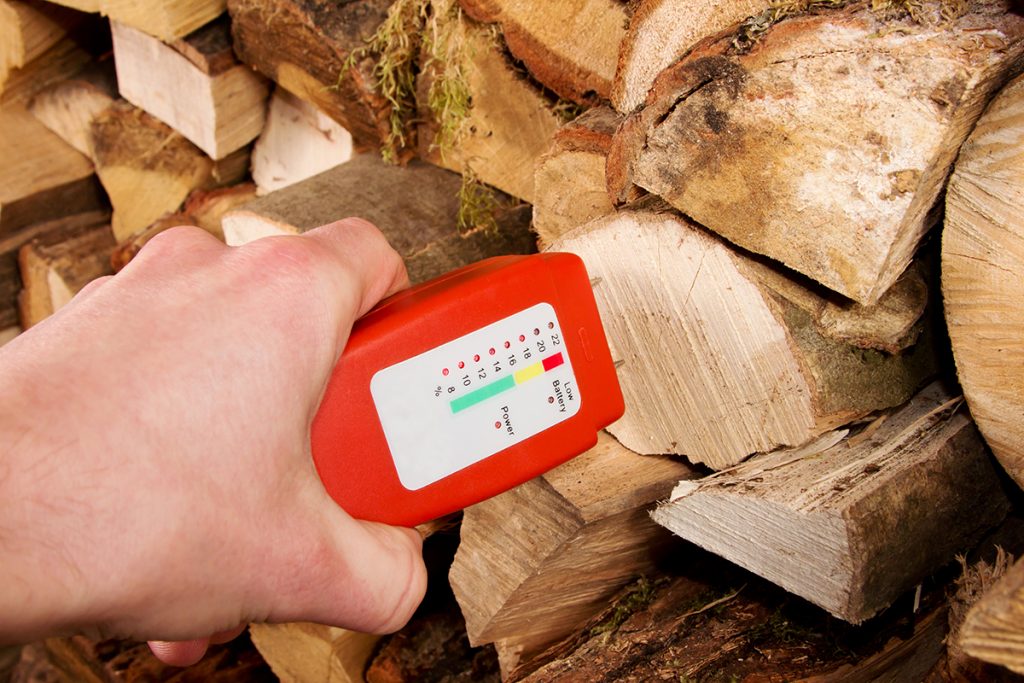
Calculating the moisture content of your woodpile is fast and easy if you use a hand-held moisture meter.  While virtually any dry wood can be used in your fireplace or wood stove, more dense hardwood species such as maples, oaks and beeches require less volume to get the same heat output (measured in British Thermal Units – BTU’s) as a much larger pile of softwood like spruce, pine or poplar. Red Oak has roughly 40% more BTU per volume than White Pine. Low density wood will keep you warm, but will require more work transporting, splitting and greater storage area.

Ms. Litchfield, went on to say, “New wood heat units with proper fuel are a clean burning energy source that deliver more heat per unit of wood than older units.  Many people see the reduction in wood use including less splitting, stacking and carrying as sufficient motivation to replace stoves over 20 years old, while others tout the indoor and outdoor air quality benefits of the cleaner burning units.”

Whether your stove is old or new, to ensure optimal performance and safety, make sure you have your chimney cleaned regularly.  This should be done annually by someone with WETT certification. Your local wood appliance retailer can refer you to a qualified company.

Other common-sense tips include having smoke and CO detectors with fresh batteries installed when you start your wood heating season. You should also have a designated place outdoors to dump ashes safely away from combustible sources.

If you have questions visit www.hpbacanada.org or your local wood stove retailer for reliable answers.

Most wood heat retailers and manufacturers in Canada are represented by The Hearth, Patio & Barbecue Association of Canada (HPBAC). The HPBAC is the Canadian industry association for manufacturers, retailers, distributors, representatives and service firms in the hearth industry. The Association provides professional member services and support and consumer education. There are more than 575 members in the HPBAC.

For more information, or to schedule interviews please contact:
Laura Litchfield, Executive Director, HPBAC laura@hpbacanada.org 1-705-784-0315

BC Gas Fireplace Regulation Update

Changes to the BC Energy Efficiency Standards Regulation are coming into effect January 1, 2019. Listed here are some important definitions, as well as amendments up to BC Reg. 29/2018, March 6, 2018. [content_control]
Definitions

ANSI Z21.50-2016/CSA 2.22-2016 means ANSI standard ANSI Z21.50-2016/CSA 2.22-2016 entitled Vented decorative gas appliances ANSI Z21.88-2016/CSA 2.33-2016 means ANSI standard ANSI Z21.88-2016/CSA 2.33-2016 entitled Vented gas fireplace heaters CAN/CSA P.4.1-02 means CSA standard CAN/CSA P.4.1-02 entitled Testing Method for Measuring Annual Fireplace Efficiency CAN/CSA P.4.1-15 means CSA standard CAN/CSA-P.4.1-15 entitled Testing method for measuring annual fireplace efficiency; FE Rating means the annual fireplace efficiency rating of a gas fireplace, vented gas fireplace heater or vented decorative gas appliance Gas Fireplace means a gas fireplace that uses propane or natural gas, including an insert or free-standing stove Vented Decorative Gas Appliance means a vented decorative gas appliance that is within the scope of ANSI Z21.50-2016/CSA 2.22-2016 Vented Gas Fireplace Heater means a vented gas fireplace heater that is within the scope of ANSI Z21.88- 2016/CSA 2.33-2016. [en. B.C. Reg. 29/2018, Sch. 1, s. 18.]

FE Rating and Label Requirements for Gas Fireplaces

33 (1) An FE rating for a gas fireplace manufactured between January 2, 2007 and December 31, 2018 must be determined in accordance with one of the testing procedures referred to in column 5 in item 12 of the efficiency standards table in section 34. (2) For the purposes of section 2 (1) (b) [prescribed label] of the Act, an energy efficiency verification label for a gas fireplace referred to in subsection (1) of this section must set out the FE rating for the gas fireplace. [en. B.C. Reg. 29/2018, Sch. 1, s. 19.] 

FE Rating and Label Requirements for Vented Gas Fireplace Heaters and Vented Decorative Gas Appliances

33.1 (1)An FE rating for a vented gas fireplace heater or vented decorative gas appliance manufactured on or after January 1, 2019 must be determined in accordance with the testing procedure referred to in column 5 in item 12.1 or 12.2, as applicable, of the efficiency standards table in section 34. (2) For the purposes of section 2 (1) (b) [prescribed label] of the Act, an energy efficiency verification label for a vented gas fireplace heater or vented decorative gas appliance referred to in subsection (1) of this section must, (a) in the case of a vented gas fireplace heater, set out the FE rating for the vented gas fireplace heater, and (b) in the case of a vented decorative gas appliance, (i) set out the FE rating for the vented decorative gas appliance, and (ii) indicate that the vented decorative gas appliance is a decorative product and is not intended to be used as a heating appliance. [en. B.C. Reg. 29/2018, Sch. 1, s. 19.]

Placement of Label on Vented Gas Fireplace Heaters and Vented Decorative Gas Appliances

33.2 (1)A person placing an energy efficiency verification label on a vented gas fireplace heater or vented decorative gas appliance referred to in section 33.1 must affix the label to the rating plate for the vented gas fireplace heater or vented decorative gas appliance. (2)For a vented gas fireplace heater or vented decorative gas appliance referred to in section 33.1 that is in a sales display, all of the information on the energy efficiency verification label for the vented gas fireplace heater or vented decorative gas appliance must be placed near that vented gas fireplace heater or vented decorative gas appliance so that the information can be easily and readily seen. [en. B.C. Reg. 29/2018, Sch. 1, s. 19.]

[/content_control]

Empire Purchases Ownership in Stove Builder International Inc.

EMPIRE COMFORT SYSTEMS INC. – The Empire Group, the parent company of Empire Comfort Systems in Belleville, Illinois, has purchased majority ownership of Stove Builder International (SBI), a Canadian manufacturer of wood-fired and pellet-fired heaters and hearth products, along with venting. Empire manufactures gas-fired heaters, hearth products, and grills.
[content_control]
Both Empire and SBI are family owned manufacturers and both have undertaken aggressive product development programs that have spurred growth in recent years. While SBI’s primary market is Canada, they also distribute into the US, South America, Europe, and Australia. Their brands include Osburn, Caddy, Enerzone, Valcourt, Drolet, Century Heating, Nexvent and Vortex. Empire’s brands include American Hearth, White Mountain Hearth, Broilmaster Premium Grills, and Empire Heating Systems.
Empire president Nick Bauer says bringing the two companies together makes sense, from a business and a personal level. “I have had two passions in my life; the first is family business, and not just my family business but doing business with other family business. Roughly 97% of Empire’s sales are to other privately held family businesses,” Bauer said.
“My second passion is local manufacturing. This value was instilled in me by my great- grandfather, who immigrated to America from Germany and founded Empire in 1932. Our commitment to local manufacturing continued for the next two generations when a lot of product was going overseas.”
During negotiations with SBI, Bauer found kindred spirits in brothers Marc-Antoine and Jean Francois Cantin – the Canadian company’s president and vice president, respectively. “It was not on the radar screen for us to sell a majority stake in our company,” said Marc- Antoine. “We have always been a market consolidator, having bought no less than eight companies over the last 15 years. But when I met Nick and realized what the two organizations could accomplish together, it did not take me too long to convince my brother. This deal will take SBI to the next level and everybody will win, starting with our employees and our customers. Such great fit is not that common. We knew we had to make a move.”
The folks at Empire share that enthusiasm. “The Bauer family is ecstatic to find partners like Marc-Antoine and Jean Francois who share these same core values,” Bauer said. “Only now I guess we need to say ‘North American-based’ manufacturing.”
While the synergy of these venerable manufacturers working together can open up new markets and new opportunities for both, the two companies will continue to operate independently – with no immediate effect on employees from either company.
Empire – Contact:
Jeff Cleveland, Marketing Manager
800-851-3153
jcleveland@empirecomfort.com
SBI – Contact:
Marc-Antoine Cantin, President
418-878-3040 ext. 231
mac@sbi-international.com
[/content_control]

New Woodstove Rebate Program for Kelowna BC

As overnight temperatures begin to dip, the timing couldn’t be better for anyone thinking of changing out their wood burning appliance, says the Central Okanagan Regional District.

There’s a new cash incentive available for Central Okanagan residents who upgrade their old wood stove to a cleaner burning one.

The provincial government is now offering a $400 rebate for replacing an uncertified wood stove with cleaner appliances, such as new pellet stoves, electric heat pumps or gas or propane stoves.

The new cash rebate is effective immediately through the Central Okanagan Air Quality program, while funds last.

The original $250 rebate that the government offered is still available for those who replace and recycle their old wood burning appliance with a new EPA/CSA-certified wood replacement.

Participating Central Okanagan retailers will take care of recycling your old stove and provide all the necessary paperwork for the applicable rebate, says the regional district.

BC Regulatory Update: New Wood Burning Regulations and PST

Please read the following and see the attached documents regarding important regulatory information on:
1) BC Ministry of Finance: The Use of PST as a Retailer
2) BC Ministry of Environment’s New Wood Burning Regulations

Understanding BC PST for Retailers & Installers

It was brought to our attention by the Ministry of Finance that they have encountered several cases involving the misuse of PST within the hearth, patio and barbecue industries. The Ministry of Finance wants to emphasize that if your business makes retail sales of goods and also installs goods into buildings or land, you are considered a contractor doing business in BC and there are Provincial Sales Tax rules you need to be aware of. In the attached document, you will find links to information pages provided by the ministry as well as contact information. Make sure you know and get the PST right!

BC’s Ministry of Environment’s New Solid Fuel Burning Domestic Appliance Regulation

British Columbia has instated new Solid Fuel Burning Appliance Regulations. In an effort to reduce the amount of particulate matter produced from wood burning appliances, the Ministry of Environment has stated that as of November 1, 2016, all new wood burning appliances sold in BC are to be certified to meet PM emissions standards set by the US EPA 2015 (4.5 gm/hr) or equivalent standards set by the Canadian Standards Association in 2010. The regulation also specifies what fuels may be burned, and has provisions around the sale and installation of outdoor wood boilers. The new regulation does not affect existing wood stoves or fireplaces.


Related Documents

City of Vancouver’s Plan to Phase Out Non-Renewable Natural Gas Not Good for Local Business: Critics

GLOBAL NEWS BC – The City of Vancouver’s plan for green buildings, which includes phasing out the use of non-renewable natural gas, has one major Metro Vancouver industry fearing it will be decimated.

Metro Vancouver is a major hub for space heating with 20 per cent of North America’s natural gas fireplaces built in the region.

“The talent is here and the ability to keep improving those products is here, it’s all homegrown,” Mike Powell of Miles Industries in North Vancouver said.

Watch for video including interview with Mike Powell of Miles/Valor Industries, and an informative interview from ResourceWorks.