The Crucial Role of Chimney Cleaning: Ensuring Safety and Efficiency

The Crucial Role of Chimney Cleaning: Ensuring Safety and Efficiency

The cozy warmth of a crackling fire in the fireplace is the ultimate comfort during colder months. However, there is a critical aspect of maintaining a safe and efficient wood burning fireplace or stove – chimney cleaning. Often overlooked, chimney cleaning plays a pivotal role in ensuring not only the safety of your household but also the efficiency and longevity of your hearth appliance. In this blog post, you’ll learn why regular chimney cleaning should be a top priority for every homeowner.

1. Preventing Fire Hazards

One of the most compelling reasons to prioritize chimney cleaning is the prevention of fire hazards. As you enjoy your wood burning fireplace, stove (or pellet stove) creosote – a highly flammable substance – accumulates on the interior walls of your chimney. Creosote is a byproduct of burning solid fuel like wood or pellets, and over time, it can build up and create a thick layer that increases the risk of chimney fires. These fires can be extremely dangerous, potentially leading to the spread of fire throughout your home. Regular chimney cleaning removes this hazardous buildup, significantly reducing the likelihood of a damaging chimney fire.

2. Ensuring Proper Ventilation

A clean chimney ensures proper ventilation for your hearth appliances. When a chimney becomes clogged with creosote, debris or animal nests, it can obstruct the flow of exhaust gases. This obstruction can cause harmful gases, like carbon monoxide, to be forced back into your living space rather than being safely vented outdoors. Carbon monoxide is colourless, odourless and highly toxic, making it a silent but deadly threat. Regular chimney cleaning ensures these gases are properly vented and maintains your home’s indoor air quality.

3. Maximizing Heating Efficiency

A clean chimney also contributes to an efficiently burning fireplace. When a chimney is obstructed, the draft necessary for proper combustion and heat transfer is compromised. This can lead to inefficient burning, decreased heat output, and an overall wastage of energy. By keeping your chimney clean, your hearth appliance can work at its optimal efficiency, saving you money on energy bills and the environment from unnecessary resource consumption.

4. Extending Appliance Lifespan

Chimney cleaning goes beyond immediate safety concerns; it also impacts the lifespan of your heating appliances. A buildup of creosote and other debris can accelerate the deterioration of your chimney’s lining, as well as the interior components of your fireplace. Over time, this can lead to premature wear-and-tear and costly repairs. Regular maintenance, including chimney cleaning, helps keep your fireplace in good working order for many years to come.

5. Professional Expertise

Look for a WETT-certified expert who will have the knowledge, tools, and experience to thoroughly clean and inspect your chimney, identifying any potential issues that require attention. A professional chimney sweep can provide you with peace of mind, knowing your chimney is in capable hands and your home’s safety is a top priority.

Do not overlook the importance of chimney cleaning! The safety, efficiency, and longevity benefits it provides are undeniable. By investing in professional chimney cleaning, you are not only safeguarding your home, but also contributing to a more sustainable and energy-efficient living environment. 

Find a service company specializing in hearth appliances near you at www.members.hpbacanada.org/find-a-member or visit wettinc.ca.

How to Properly Clean Your Barbecue

How to Properly Clean Your Barbecue

Generally, people clean their barbecue every season. Cleaning your grill is critical because you cook your food on it and, more importantly, it can catch fire if it’s not properly cared for. A fire can start at the bottom of the unit, where the grease collects, and the resulting intense heat can be problematic. Additionally, marinades, spices, salt and/or grease can slowly start to eat away at the stainless steel or metal of the unit. Maintenance is therefore necessary, especially if you are unsure of the quality of the stainless steel.

The first thing you should do when you’re about to clean your barbecue is to move your appliance onto grass or rocks. You don’t want to damage your patio, your flagstone or your favorite slab of concrete, because grill cleaning products are quite powerful. Set yourself up somewhere with no direct sunlight, especially if your BBQ has a baked coating or stainless steel parts, because some products can stain; if it’s sunny where you set up, make sure to leave the product on for less time.

If your barbecue has a propane tank, remove it. Completely “close” the tank, pull it out and unscrew the regulator. Then, to make sure you are working safely, burn off the remaining gas in your barbecue. If you see a flame emerge, let it “burn” until it goes out completely. Watch the flame carefully because if it’s uneven or of a different color (blue on one side and yellow on the other, for example), you may need to unclog or replace the burners.

Next, remove the grates, heat deflectors and grease pan (after quickly cleaning them) from your barbecue to access the bottom of your unit. Fill half a large bucket with hot water and soak your grates, deflectors and pan. When the water starts to turn brown, empty out the bucket and fill it with clean hot water. Pour about half a bottle of grill degreaser into the water and let the product do its job for about 4 to 5 minutes. If necessary, scrub the parts in the water to help the product work even better. When the time is up, be sure to rinse everything thoroughly.

Grill degreasers are very effective. Grease stains on your barbecue’s surfaces will disappear and your unit will look brand new. Be careful not to inhale the product or get it on your skin; it’s important to use gloves when handling it.

While the grates, heat deflectors and grease pan are soaking, use a grate scraper to thoroughly scrape off all the chunks and grease stuck to your barbecue’s fire box and burners, scraping your grates and heat deflectors first. Dirt on the surface should dissolve in a matter of seconds. When it comes to cleaning the fire box, Max recommends working with plastic or composite tools.

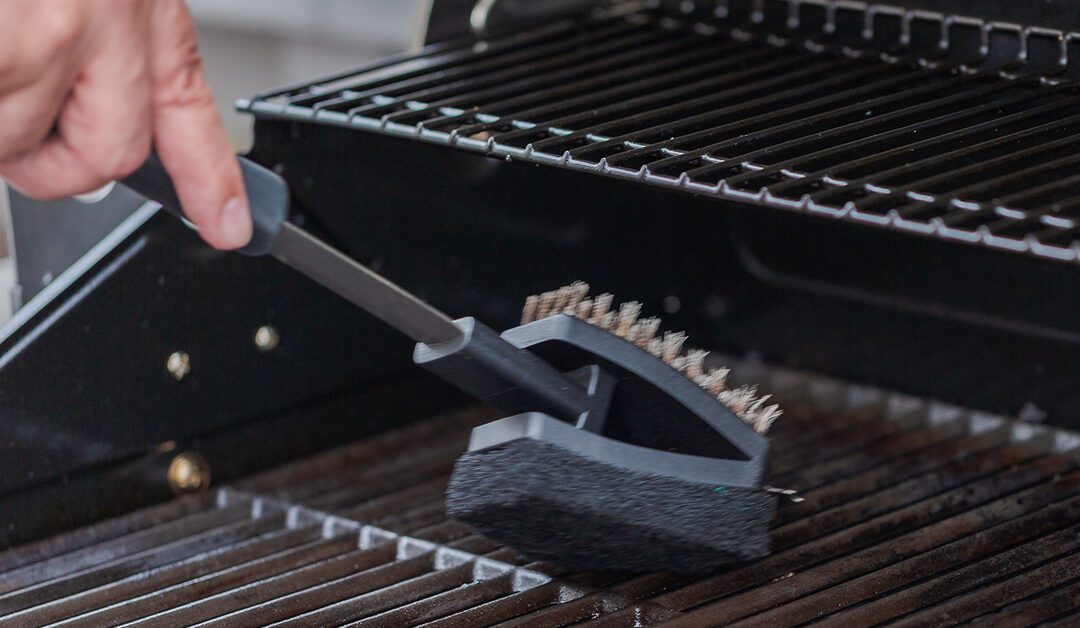
To really get your burners clean, use an angled grid cleaning brush to remove any small bits (whether fat or carbon) which have built up and clogged the holes. This type of brush also does a great job of cleaning the sides of the burners and the channels, which carry gas from one burner to another. If you’d like to unclog each hole in your burners, use a port hole cleaner, which is designed for this purpose.

If your burners are still clogged at this point, remove them from your barbecue and clean them with a venturi brush, which reaches deep inside your tube burners (or venturi tubes), either if your burners are staggered or set in a straight line.

Once your barbecue is clean, spray it with a grill cleaner or degreaser. Brown/orange liquid may drip from the barbecue, which is normal as it is removing grease from the unit’s surface. If your barbecue changes color a little after applying degreaser, don’t worry. That’s normal too.

Max recommends using degreaser on all parts of the barbecue – the burners, heat deflectors, grates, shelves, tank, handles, knobs, the cart and on the inside of the lid – but feels you can spare your regulator. Allow the product to work slowly for 4 to 5 minutes, then rinse everything well afterwards – you can even use a pressure hose, or scrub with a brush while rinsing – until you no longer see any little bubbles in the water.

Once everything is well rinsed, put on your sunglasses and use a barbecue polish or shine restorer to wipe down all the parts/surfaces of your unit. Blemishes, fingerprints and anything unattractive will disappear, and your barbecue will look like it came straight from the store!

After cleaning your grill, if you suspect that one or more of its parts is defective or causing problems, do not hesitate to contact your local specialty retailer.

Find a specialty retailer near you at www.hpbacanada.org/retail-service-providers.

Happy cleaning and happy grilling!

Max Lavoie
House of BBQ Experts

HPBAC Announces Mike McNeice as Director of Public Affairs

The Hearth, Patio & Barbecue Association of Canada (HPBAC) is pleased to announce that Mike McNeice has joined our association as Director of Public Affairs. McNeice officially began work on Thursday, April 13, 2023. “Mike is a welcome addition to our team.” said Laura Litchfield, President. “He brings a wealth of experience from the organizations he’s worked with in the past that will be of great benefit to our association.”

McNeice has spent over ten years in public affairs in a variety of roles. Most recently, he worked with the Ontario Real Estate Association as their Senior Manager of Government Relations and Advocacy. He has extensive experience in stakeholder relations and strategy development.

“I’m excited to be part of this great organization,” said McNeice. “I look forward to building strategic partnerships and continuing to build on HPBAC’s incredible work, which has already contributed so much to the advancement of this industry.”

Mike can be reached at mike@hpbacanada.org.


Contact:

Meghan O’Reilly
Public Affairs Manager
Hearth, Patio & Barbecue Association of Canada
647-701-9174
meghan@hpbacanada.org

What’s the Best Grill for You?

What’s the Best Grill for You?

May is National Barbecue month in Canada, the perfect time for grillers to visit their local specialty retailer to stock up on accessories and patio supplies, and to check out the latest in new grills.

While many of us grill all year long, it can become our primary way of cooking during the warmer months. Whether you’re replacing an old grill or looking to try something new, making the right choice will give you years of enjoyment in your backyard and at the table.

With many types of grills in all forms, sizes, and prices adorning a retailer’s showroom floor, which is the right one for you? Here’s a quick guide.

  1. Gas: For people who want convenience. Just like your kitchen stove, it can be ready to cook in 10 minutes, and it’s easy to regulate cooking temps.
  2. Charcoal: For those who love being hands-on with the nuances of outdoor grilling. Some say charcoal provides the best flavour experience. Good for low and slow cooking AND high heat searing.
  3. Pellet: For people who want the most flavour. Wood pellet grills are among the most energy efficient and burn clean. With pellets coming in hickory, mesquite, and oak varieties, you, your friends, and your family can enjoy a truly flavourful cooking experience.
  4. Electric: For people who love simplicity. Electric grills are designed to produce constant heat and operate without an open flame. Ideal for apartment or condo dwellers since they don’t require charcoal or propane.
  5. Kamado: For people who love cooking of all styles and seasons. Kamado Grills’ excellent insulation is ideal for both grilling and smoking. They can use wood and charcoal and are ideal for roasting and baking.

Happy grilling!


Click here to find a specialty retailer near you.

Comox Valley Residents Support Wood Burning

Comox Valley Residents Support Wood Burning

Survey Reveals that Residents Want Alternatives to Bylaws Restricting Wood Stoves

(COURTENAY) – Residents of the Comox Valley recently responded to a survey (conducted by Leger) regarding opinions towards wood burning. 300 local respondents aged 18 and older participated in the telephone survey, which took place from September 23 to 29, 2022.

Results reveal a clear mismatch between the Comox Valley Regional District’s (CVRD) current policy direction and local public opinion. Among residents, there is strong agreement (92%) that people should be able to upgrade their old inefficient heating systems with a newer, cleaner burning system of their choice. Furthermore, 79% agreed that this choice should be left up to residents, not local government.

Residents also indicated how bylaws restricting wood stove installation will influence their vote during the upcoming election. Generally, residents are more likely to oppose these bylaws (31%) than support them (20%), and after learning about the Hearth, Patio & Barbecue Association of Canada’s (HPBAC) Three Pillar Plan for addressing regional air quality, over half (56%) of residents said they were likely to vote for a municipal candidate who supports the HPBAC solution.

As an alternative solution to addressing air quality in the Comox Valley, HPBAC presented the Three Pillar Plan to local government in 2021. The plan proposes a comprehensive public education program on better burning practices, along with a targeted wood stove exchange program, and a dry and seasoned wood lot to make proper fuel more accessible. Collectively, these activities will translate into cleaner burning and improved air quality throughout the community.

“This reaffirms what the community wants,” said Jeff Loder, Director of Public Affairs for HPBAC. “When you compare these findings with the current discourse around wood burning, public opinion just doesn’t line up with what we’ve seen from the CVRD.”

The survey showed that just over one-quarter of Comox Valley residents use wood burning for at least some of their home heating. When asked about the practicality of electric heating, only 30% of residents believe it’s feasible for everyone in the region to switch to 100% electric heating.

“Residents of the Valley rely on their wood stoves, and these results support that,” said Jamie Payne, Owner & Operator of Norse Heating in Comox. “We face frequent power outages and other available heating options are often too expensive, so it’s not hard to understand why wood stoves are a necessity for so many people.”

Results also showed that public awareness of bylaws limiting the installation of wood stoves has increased over the last year. “The results illustrate that public consultation was insufficient, and the people are looking for a better way forward” said Tomi Wittwer, Owner & Operator of Comox Fireplace and Patio.

The Hearth, Patio & Barbecue Association of Canada is the national not-for-profit industry association that represents businesses which produce, sell, or service appliances and accessories in the hearth and barbecue industries in Canada.

For more information on HPBAC’s Three Pillar Plan, visit: www.saveourwoodstoves.ca/wpcontent/uploads/2022/08/New-TPP-Presentation.pdf 

To learn more about the Comox Valley bylaws that restrict the installation of wood stoves, visit: www.saveourwoodstoves.ca/wp-content/uploads/2022/08/HPBA_11536_Bylaw_Info_Sheet.pdf

Is It Time For A New Fireplace?

Is It Time For A New Fireplace?

It’s that time of year – the days are getting shorter and the nights cooler, which means we can start enjoying our hearth appliances. If you haven’t yet performed the yearly maintenance that ensures your unit is in good working order, please read our article on preparing for the season.

For some, it might be time to consider replacing their old unit with a newer, more efficient model. The best way to determine the age your appliance is to contact the manufacturer of the product. You’ll need to provide the full model and serial numbers directly to the company in order to obtain this information.

Model and serial numbers are key to finding information, getting service and ordering parts for your hearth product. These numbers can be found on the ‘rating plate’, a metal plate that’s usually permanently affixed to the fireplace, insert or stove. Access to the plate may require the removal of some parts and accessories.


Woodburning Appliances

On factory-built wood-burning fireplaces, these numbers will be on a metal plate which can be located in a variety of places, depending on your product:

  • Inside the bottom of the fireplace behind the bottom louver or faceplate (the bottom louver or faceplate will need to be opened or removed)
  • The bottom front of the stove, under the ash-lip (the fan will need to be removed first),
  • The upper left side or right side of the firebox
  • Riveted on the smoke shield behind the screen

Gas Appliances

On gas appliances and inserts, the serial/model/rating plate should be in one of the following:

  • The lower cavity controls area
  • The control compartment area (the decorative front and vanity panel may need to be removed)
  • Below and behind the fireplace’s lower louver
  • Attached to a gas line or stamped on the floor of the insert

A wood burning fireplace will need to be replaced when critical parts deteriorate and replacements become unavailable. Parts are usually available for a minimum of 7 to 10 years after the fireplace has been manufactured.

Repairs are possible with available replacement parts but some issues are not repairable and require that the homeowner replace the fireplace. This would include deterioration of the firebox or heat exchangers. These are most commonly due to lack of regular maintenance or general misuse by the operator.

Gas burning units are less prone to such failures because they are generally not used for long periods of time. Since these types of fireplaces are often used for decorative applications or zone heating, the length of time in which they are used in a season can be significantly less when compared to other products, resulting in a potentially longer life cycle.

We recommend you call a professional WETT-certified chimney sweep to clean and service your wood appliance. For gas appliances we recommend using a gas fitter for cleaning and service.


You can find specialty hearth retailers and service experts by visiting hpbacanada.org/find-a-member/retailers-and-service.